Studio Notes
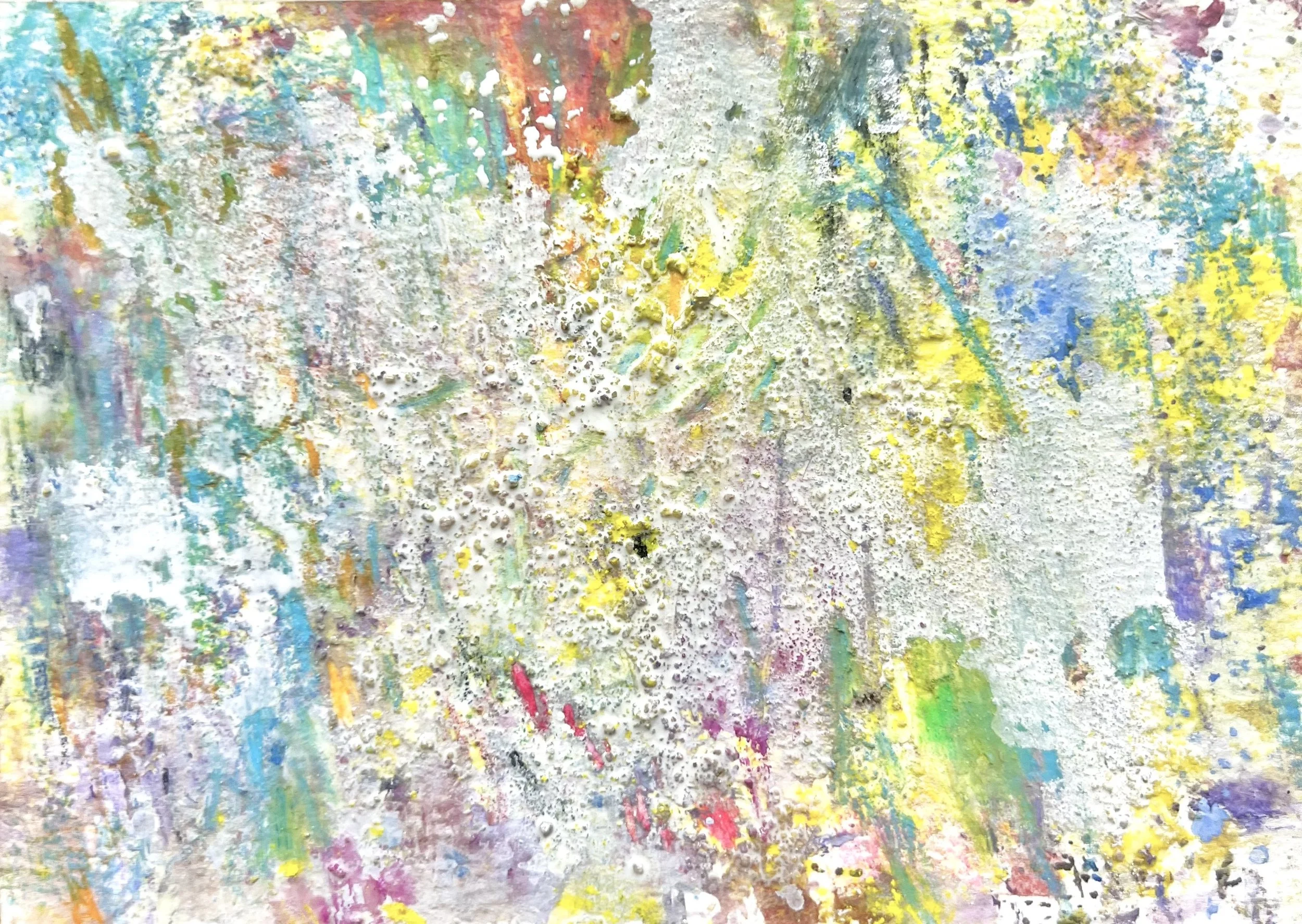
A few days ago, I finished a stage of a painting. When I came back to the studio the next morning, sunlight was falling across it. I stopped and stared. I knew it was my painting, but I could hardly recognise it.
I remembered making the marks, covering parts of the surface and letting others show through. I remembered how it had looked when I left it. Yet in that light, the marks seemed to have come together into something whole. I sat down and stayed with it quietly, though I felt anything but quiet inside. Later, I lay on the floor beside it. I held it and touched its surface, as though I were getting to know someone again. We had only been apart for a night, but I felt almost as moved as if I were seeing a daughter I had lost touch with ten years ago.
I kept wondering how I could know, so certainly, that I had made it and still feel that I didn’t recognise it.
In On the Relation of Analytical Psychology to Poetry, Jung describes a work taking shape in the artist’s mind as something with a degree of autonomy. Read Jung’s essay. I take this as a way of thinking about the creative process, rather than a claim that a painting has a mind of its own. I made this painting, but I couldn’t have known exactly what all those marks would become together. While I was working, I was too close to it. After a night away, I could look at it almost as I might look at someone else’s work.
The psychologists Dacher Keltner and Jonathan Haidt describe awe as an experience that exceeds our usual way of understanding things and asks us to adjust it. The sense of something being “vast” need not be about physical size; it can also be about meaning. Awe, in their account, may involve unease as well as beauty. Read “Approaching Awe”. Perhaps that is why the painting unsettled me. The canvas had not grown larger overnight. I had simply found that my idea of it was too small.
William Blake wrote of seeing “a World in a Grain of Sand”. Read Auguries of Innocence. For a moment, the painting felt a little like that. It was still a canvas in my studio, but it seemed to hold time, feelings and memories I had never set out to put there. I recognised the brushstrokes, yet they led me somewhere unfamiliar.
That mixture of familiarity and strangeness brought to mind Freud’s essay The Uncanny, in which he considers how something familiar can come to feel strange. Read The Uncanny. I am borrowing that description of a feeling, rather than trying to draw any conclusion about my own memories. What disturbed me may simply have been that the painting was mine, while no longer feeling entirely within my grasp. I could recognise its parts. I needed more time with it as a whole.
So I stopped working on it. I know a surprise can be a happy thing, but looking back, surprises have often struck me with more force than I expect. I feel at times like a thin sheet of washi paper: even good news can pass through me like an arrow. Only the day before, the painting had been changing under my hand. Now it was meeting me with a new face. The parting and the reunion had happened too quickly for me to keep up.
I began to stay away from the studio. For a few days, I could hardly bring myself to go in. Still, I carried the painting’s marks with me. It felt as though an invisible cord ran between us. I needed some distance, but I remained attached to it. Perhaps holding and touching it was my way of feeling that connection again. It had become strange to me, and I wanted to get to know it slowly.
When Keats wrote about “negative capability”, he valued the ability to remain with uncertainty and mystery without hurrying towards an explanation. Read his letter to his brothers. I would like to learn to look in that way. I still don’t know where the next mark should go, and I’m not quite ready to enter the studio every day. For now, this pause feels part of continuing the painting. I need to sit with it for a while, let myself feel both the surprise and the unease, and give myself time.